SaaS to Self-Hosted: How ShopForge Orchestration Makes Shopware 6.7 Migration Feel Like Shopify
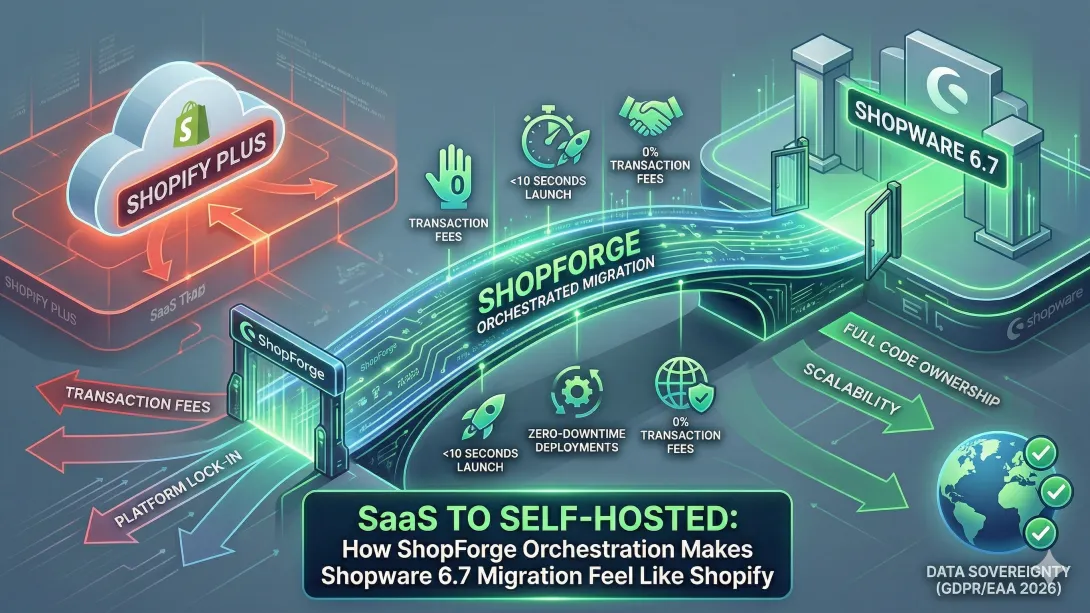
In 2026, the e-commerce landscape is witnessing a massive "Great Replatforming." For the last decade, the narrative was simple: pick a SaaS like Shopify for ease and reliability, or choose a self-hosted platform like Shopware for freedom and customization. However, as Shopify increases its "Plus" transaction fees and restricts checkout extensibility, high-growth brands are hitting a ceiling. They want the 0.0% transaction fees and B2B power of Shopware 6.7, but they are paralyzed by the fear of the "Infrastructure Gap"—the manual server management, the messy deployments, and the "it’s down and I don't know why" anxiety.
ShopForge was built specifically to close that gap, turning the complex transition from a "walled garden" to an open-source powerhouse into a seamless, automated experience.
The "SaaS Trap" and the Hidden Costs of 2026
The convenience of SaaS comes at a price that isn't always visible on the invoice. Even on Shopify Plus, brands are penalized for success. At a $50M ARR, a 0.20% third-party transaction fee amounts to $100,000 annually—essentially a "growth tax." Furthermore, because you cannot modify the core code in a SaaS environment, brands often end up with dozens of apps, each with its own subscription, script tag, and performance drag.
With the European Accessibility Act (EAA) June 2026 deadline looming, brands now require granular control over how their data is served and accessed—control that SaaS platforms often obscure. Moving to Shopware 6.7 on ShopForge allows you to reclaim that control without taking on the burden of traditional server maintenance.
Orchestration: Making Self-Hosted Feel Like SaaS
The biggest culture shock for a Shopify user moving to self-hosting is the word "Provisioning." Traditionally, getting a Shopware environment ready involved manual server configuration, database setup, and PHP tuning. On ShopForge, that "Self-Hosted is Harder" myth is officially dead. Through our Kubernetes-native architecture, launching a production-ready Shopware 6.7 environment takes less than 10 seconds.
We’ve replaced manual Linux administration with automated orchestration. When you migrate to ShopForge, you aren't "renting a box"; you’re launching an automated factory. You get the "turnkey" feeling of SaaS with the full root-level freedom of Shopware. If a PHP process hangs or a node fails, our orchestrator automatically replaces it before your customers—or your monitoring—even notice.
Technical Performance for the Modern Store
Shopware 6.7, released in February 2026, introduced architectural shifts like Edge Side Includes (ESI) and Delayed Cache Invalidation. If your host isn't tuned for this, you're driving a Ferrari in first gear.
Most "Premium" hosts still use a generic Varnish or Nginx setup that treats the whole page as one block. This forces the server to re-render the entire page every time a customer adds an item to their cart. ShopForge’s stack is natively built for ESI. We cache 99% of the page at the edge, only "poking a hole" for dynamic fragments. This results in a Time to First Byte (TTFB) of under 50ms, even for logged-in customers.
Additionally, we provide a Multi-Instance Redis Stack by default. We separate session data from the app cache to prevent "lock-contention"—ensuring your checkout stays fast even when your ERP is performing heavy indexing in the background. Unlike SaaS platforms where you share "Liquid" processing power with thousands of other stores, ShopForge gives you isolated compute. Your PHP workers are always "warm" and dedicated solely to your brand.
The Financial Reality: Shopify Plus vs. ShopForge TCO
When we look at the Total Cost of Ownership (TCO) in 2026, the numbers are undeniable. For a brand doing $12M in annual revenue, the "SaaS Tax" is significant. Between platform fees, transaction fees, and app subscriptions, a Shopify Plus merchant can easily pay upwards of $70,000 in overhead.
By moving to Shopware 6.7 on ShopForge, that overhead often drops by 70%. Because Shopware is Open Source, there are no platform fees. Because ShopForge is an orchestrated platform, the infrastructure costs are predictable and transparent. You stop paying a "success tax" on every sale and start investing that capital back into your own customer acquisition and product development.
The Zero-Downtime Migration Safety Net
The fear of "The Big Switch" is what keeps merchants on SaaS. On many self-hosted setups, pushing a code change or migrating data means taking the store offline for a "Maintenance Mode" window. ShopForge introduces Atomic Deployments.
Every time your developers open a Pull Request (PR), we spin up a complete, temporary clone of your store in 10 seconds. You can test the migration, the data mapping, and the performance in a 1-to-1 production environment before a single customer sees it. Using our Kubernetes-native architecture, we build your new code in an isolated pod and switch the traffic over only when health checks pass. The transition is instantaneous and invisible to your customers—exactly like the SaaS experience they’re used to.
Conclusion: Owning Your Future
In 2026, agility is the only currency that matters. Staying on SaaS means renting your success and hoping the platform’s limitations don't stifle your growth. Moving to Shopware 6.7 on ShopForge means owning your foundation. You no longer have to choose between "Easy" and "Powerful." With ShopForge, you get the Shopify experience on a platform that has no limits. It’s time to move from a "walled garden" to a high-performance orchestrated platform.