The 2026 Shopware Hosting Showdown: Why "Managed Hosting" is No Longer Enough
Choosing a hosting provider from the official Shopware partner list feels like a safe bet. You see names like Hypernode, various AWS-managed services, and budget cloud providers. They all promise 99.9% uptime and SSD storage.
But in 2026, uptime is a commodity. The real bottleneck for Shopware 6 isn't the server—it’s the workflow.
If your hosting provider gives you a fast server but leaves you to manually configure your CI/CD pipelines, struggle with local Docker environments, and pray during production deployments, you aren't buying a solution; you’re buying a second job.
1. The Three Tiers of Shopware Infrastructure
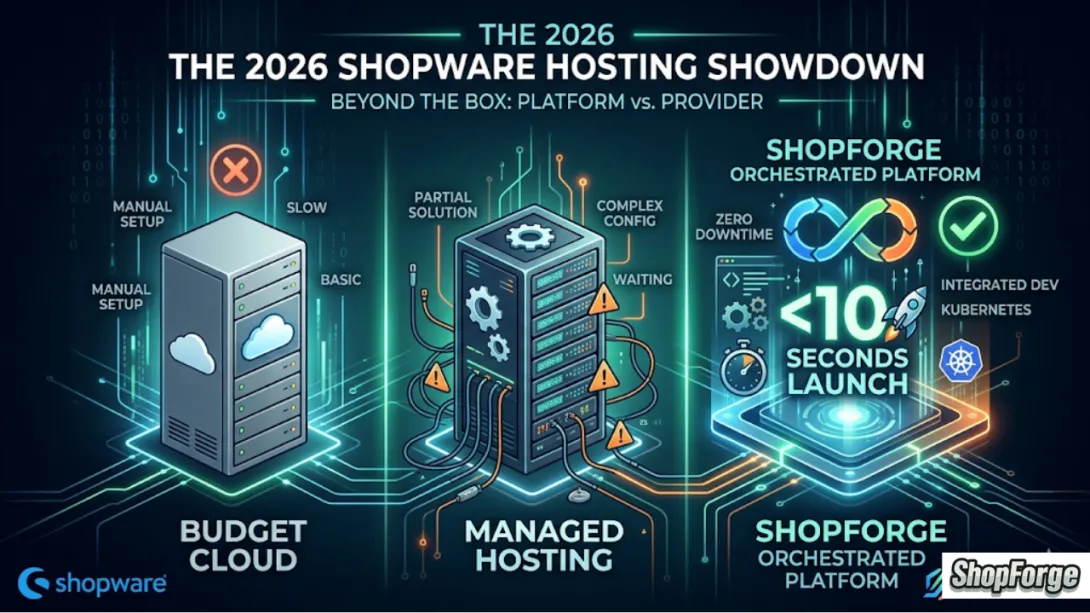
To understand where your business fits, you need to look past the marketing jargon. Most "Shopware Hosting" falls into one of three buckets:
| Feature | Budget Cloud (Utility) | Managed Shopware Hosting | ShopForge (Orchestrated Platform) |
|---|---|---|---|
| Best For | Sandboxes & Hobbyists | Established Mid-Market Stores | Agile Agencies & Fast-Growth Brands |
| Setup Time | Instant (Empty Box) | Hours/Days (Manual Config) | <10 Seconds (Full Stack) |
| Local Dev | "Do it yourself" | Limited / Generic | Integrated (DDEV/Docker/Vagrant) |
| Deployments | Manual FTP/SSH | Basic Git-push | Zero-Downtime Pipelines + PR Previews |
| Focus | Lowest Price | Server Performance | Developer Velocity & ROI |
Note: While Shopware’s official partner directory lists dozens of hosts, very few bridge the gap between "hosting" and "development workflow."
2. The Hidden Cost of "Cheap" Hosting
Providers like CloudClusters attract merchants with low monthly fees. On paper, it looks like a win. However, for a Shopware 6 store in 2026, "cheap" often translates to:
Generic Stacks: Using the same PHP/MySQL config for Shopware as they do for a basic WordPress blog. Shopware 6.7 requires specific PHP 8.2+ and MariaDB 10.11+ optimizations that generic hosts often miss.
No Shopware-Specific Caching: Without pre-configured Redis 7.0 and Varnish tuned specifically for the Shopware 6 core, your TTFB (Time to First Byte) will suffer, killing your SEO rankings.
The "DevOps Tax": You will spend thousands of dollars in developer hours setting up what should be automated: SSL, backups, and staging environments.
3. The ShopForge Advantage: Why Velocity is the New Uptime
In the traditional hosting model (the ones you see on the Official Partner lists), "launching" a store is an event. You wait for a server to be provisioned, you manually install dependencies, and you cross your fingers.
ShopForge changes the narrative from "Waiting for Servers" to "Building for Customers."
The 10-Second Infrastructure Reality
Imagine a world where your development team doesn't spend Monday morning setting up a staging environment for a new feature. With ShopForge, we’ve reduced the "Infrastructure-as-a-Service" delay to virtually zero.
Instant Parallelism: Need a fresh environment to test a Shopware 6.7 update or the new European Accessibility Act (EAA) compliance features? You have it in 10 seconds.
PR Preview Environments: Every time a developer opens a Pull Request, ShopForge can spin up a dedicated, isolated environment. No more "it worked on my machine" bugs reaching production.
Kubernetes-Powered Resilience: While budget hosts put you on a single VPS (where one hardware failure takes you offline), ShopForge leverages a containerized Kubernetes architecture. If a node fails, your store heals itself.
4. Beyond "The Box": An Integrated Ecosystem
The biggest flaw in the pages of traditional premium hosts—from Hypernode to maxcluster—is that they treat hosting as an isolated silo. They give you a place for your code to live, but they don't help you write or move that code.
ShopForge is an "All-in-One" Shopware Factory:
Local Development: We bridge the gap between your laptop and the cloud. Whether you use DDEV, Docker, or Vagrant, your local environment is a mirror image of your production server.
Automated CI/CD: We don't just host; we deploy. Every commit is tested and moved through a professional pipeline automatically.
Zero-Downtime Deployments: Most hosts require "Maintenance Mode" for updates. ShopForge uses atomic deployments. Your customers never see a 503 error, even while you’re pushing major code changes.
5. Decision Framework: Which Should You Choose?
Choose Budget Hosting (CloudClusters/DigitalOcean) if you are a developer learning the ropes with a personal project where downtime doesn't matter.
Choose Managed Hosting (Hypernode/maxcluster) if you have a stable store with few code changes and just need a reliable, high-performance "box."
Choose ShopForge if you are an agency or a growing brand that pushes code daily, needs instant staging environments, and wants to eliminate the friction between development and production.
Conclusion: Stop Renting Servers, Start Scaling Platforms
If you are looking for the cheapest place to park a domain, the generic cloud is fine. But if you are building a brand on Shopware 6, you need more than a "host."
You need a platform that understands the Shopware App System, optimizes for Flow Builder events, and respects your Developer’s time.
Ready to see the 10-second launch in action?